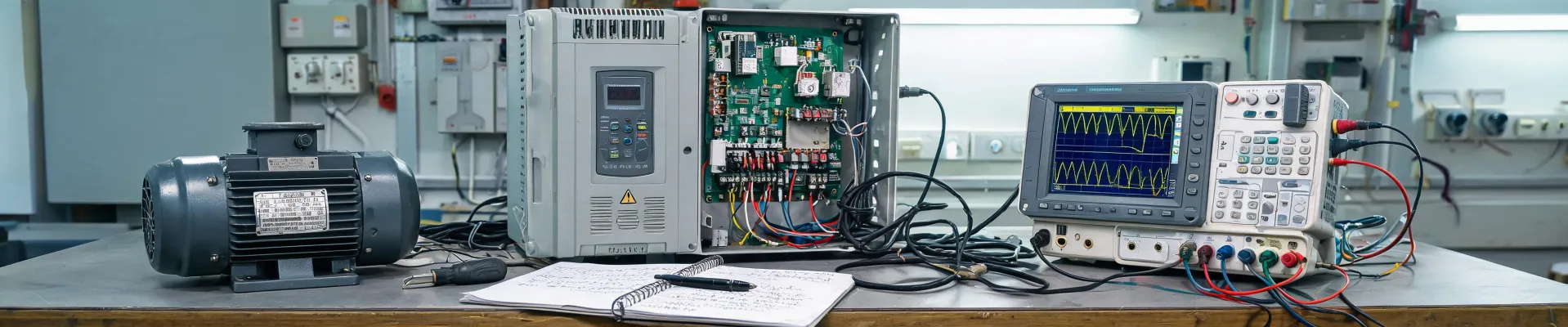
Since 2017, I've handled controller wholesale orders and ABB VFD project quotes for B2B customers. In nine years, I've made—and documented—nine ordering mistakes totaling roughly $41,000 in wasted budget. None happened because I didn't care. They happened because a part number looked right, or a line item got copied too quickly. Some happened because I trusted a cached quote instead of checking the current type code. Now I maintain the pre-order checklist. This FAQ is the version I share with new buyers and sales engineers, and every answer comes from a mistake that's already on that list.
Which ABB VFD fault codes should worry you most?
On the ACS5xx drives we see in the field, F0001 (overcurrent), F0002 (DC overvoltage), and F0003 (DC undervoltage) account for most of the fault-code calls. It's easy to read them as the drive being broken. In my experience, that's often not the case.
F0001 shows up when output current exceeds the drive's limit. The usual suspects are acceleration times that are too short, motor cables that are too long, or a motor drawing an unbalanced current. F0002 often appears during deceleration when the motor feeds energy back into the DC bus. Fixing the decel parameter or adding a brake resistor solves it more often than replacing the drive. F0003 means the DC bus voltage dropped below the drive's threshold. I've traced that to loose input connections, a failing fuse, and once to a bad contactor on the supply side.
If the fault repeats at the same point in the cycle, don't assume the electronics failed. Write down the motor nameplate data, the current value at trip, and what was happening before the fault. That pattern is worth more than the fault number alone. If you can, read the fault history stored in the drive panel; that log is some of the most useful data you can send to a supplier or service person.
Why doesn't an ABB VFD fault code always mean the drive has failed?
When I first started, I thought a fault code was the drive telling me what to replace. Here's the thing: a code is a clue, not the verdict.
In 2022, a customer's ACS550 kept tripping on F0001. We bench-tested the drive under no load and it ran fine. The maintenance team was ready to buy a replacement. I asked them to inspect the motor branch circuit first. They found a contactor in the motor line with one badly pitted pole. Under load, the motor was effectively single-phasing, which pulled high current and tripped the drive. A new drive would have tripped the same way.
We call those ghost faults. They disappear in the shop and come back in the plant. The lesson is to check the whole circuit before approving a repair. I also ask: What changed before this fault? A recent motor rewind, a new cable, or a re-routed control wire can be the real trigger. Every fault log we write up now includes that change history. When I look at a fault now, I don't ask if the drive is bad. I ask if the conditions around the drive passed their own check. That simple shift has cut our average diagnostic time almost in half.
Which controller specifications matter most in a wholesale order?
In controller wholesale orders, I've learned to treat every voltage spec as a potential time bomb. Timers, contactors, relays, and PLCs can look identical but run on completely different supplies. 24 V AC and 24 V DC may share the same housing and socket, but they are not interchangeable. I've also seen a 230 V control component ordered for a 400 V control transformer because someone looked at the primary side of the transformer instead of the load side.
I once quoted 60 timers with 24 V DC coils for a panel builder whose old parts were 230 V AC. The mistake came from copying the previous line item too fast. We caught it only because the customer sent a close-up photo of the old nameplate before approving the PO. That catch avoided roughly $1,800 in rework and a two-week delay. Wholesale quantities make small errors louder: one typo becomes 60 wrong devices on the same pallet.
Since then, our controller specification checklist includes:
- Supply voltage, AC or DC, and the exact range
- Output contact type and rated current
- Mounting style: socket, DIN rail, panel, or direct wiring
- Approvals needed for the destination market
It sounds basic, but the checklist has caught 47 mismatches in 18 months. Most were one-letter differences between model suffixes.
What should a real timer wholesale cost guide include?
Most timer wholesale cost guides stop at unit price. That's the least useful part. A timer's installed cost also includes the socket or base, the expected life in a control panel, and the cost of downtime if it fails in service.
In 2020, I bought 40 bargain timers because they were about $6 cheaper each than the part we normally stocked. The $240 saving looked like a win. Within eight months, six failed in the field, and two stopped a production line. The additional service calls, freight, and lost trust cost us roughly $1,900. Prices and freight rates may have moved since then—this was current in early 2026—but the pattern hasn't.
When we put together a timer quote now, we compare datasheet availability, local stock, and whether the manufacturer publishes the expected life at rated current. Ask how many units are in the batch, whether the vendor can provide lot traceability, and whether it will share a certificate of conformance. A distributor that cannot answer those questions is not a source; it's a middleman with a shopping cart. If a listing cannot provide a datasheet, I won't spec it.
What should you check before every ABB VFD wholesale order?
The main type number is the beginning, not the end. ABB VFDs can include different enclosure classes, fieldbus adapters, I/O option boards, control panel types, and firmware levels. Two drives with the same basic model name can behave differently in your customer's network.
In 2021, I placed an order for ten ABB VFDs using a cached quote. The base model was correct; the option suffix was outdated. The customer needed a fieldbus adapter for their PLC network, but those drives arrived without it. We had to ship adapters overnight, fit them on site, and reschedule startup. The extra cost was about $900, plus a meaningful dent in trust.
Now I ask for the complete type code in writing on every ABB VFD wholesale quote. If a procurement sheet lists only the short model, I stop and go deeper. I also check that the drive manual or fault code list matches the installed firmware version. Confirm the warranty terms and whether the supplier stocks spare I/O boards and control panels. If a drive faults after startup and you need a spare part, waiting eight weeks in production is not acceptable. A good wholesale supplier keeps service stock; a bad one only has a price list. Those small checks stop big surprises.

Rebecca Sloan
Rebecca Sloan is a power distribution and protection analyst specializing in circuit breakers, switchgear, contactors, fuses, surge protective devices, and coordination. She applies IEC 60947-2 breaker requirements, IEC 60269 fuse characteristics, and IEC 61643-11 tests while examining rated voltage, breaking capacity, time-current curves, selectivity, and prospective short-circuit current. She helps engineers and buyers compare protective devices against documented fault levels, installation conditions, maintenance access, and continuity priorities.