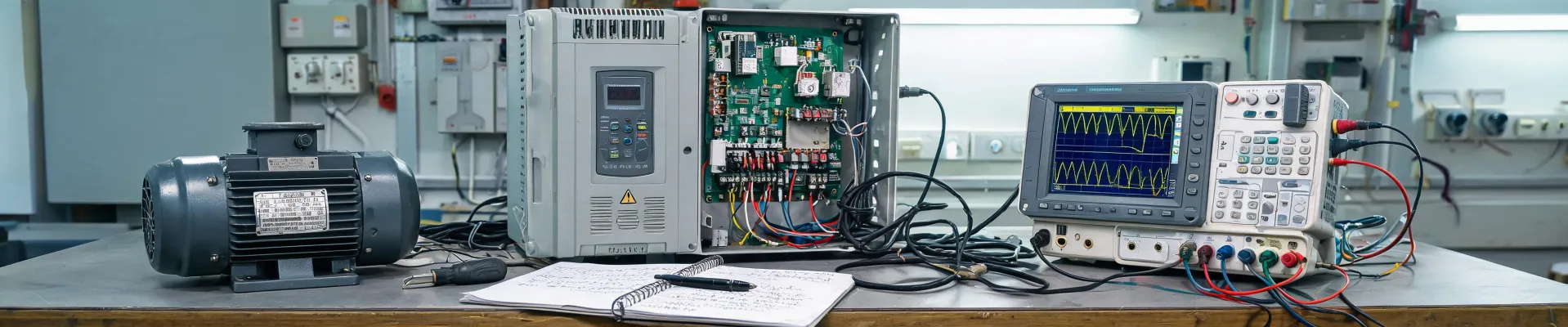
Conclusion: the expensive line item is rarely on the quote
Bottom line: I have made roughly $28,000 of purchasing mistakes across ABB VFD drives, ABB VFD drive training courses, PLC private label agreements, safety PLC catalog orders, and wholesale timer purchases. Every one followed the same pattern: I optimized the price I could see instead of the requirements I couldn't. The most expensive part of any industrial control order is whatever you assumed was included.
I handle B2B component sourcing for an industrial controls supplier, which is a careful way of saying ABB VFD drives and related components take up most of my working life. In nine years, I have personally made and documented five significant mistakes. They added up to about $28,000 in wasted budget, not counting the embarrassment. Since 2023, I have maintained a checklist that catches most of these errors before they leave the inbox. This article is that checklist, with the stories behind it.
The four mistakes that taught me the pattern
ABB VFD drive training: the cheap course was not the cheaper option
In March 2022, I booked ABB VFD drive training for two maintenance technicians. I did what a lot of buyers do: compared course prices, saw a generic 'variable frequency drive' program for about 30 percent less than an ABB VFD drive training course aligned with our drive family, and booked it. The course provider looked credible on paper.
The content was fine for theory. It was useless for our specific problem: intermittent fault codes on ABB VFD drives on packaging lines. The instructor had general VFD experience but had not worked on ABB drives recently. The course taught generic parameter structures, not the ABB parameter groups our machines used.
Our technicians came back with good notes and limited confidence. Over the following six months, we logged roughly $5,200 in downtime and support calls that trace back to the training gap. I am not against generic training. I am against choosing training without asking 'will this specific person be able to troubleshoot the specific drives we own?'
The ABB VFD drive training course with hands-on fault-code work would have cost more upfront. It also would have paid for itself the first time one of our techs correctly diagnosed a failing brake chopper instead of waiting for remote support.
PLC private label: the visible price was the trap
The PLC private label lesson came in late 2021. One of our OEM customers wanted their brand on a PLC family, and I was tasked with evaluating a private label supplier. The quote was attractive: about 18 percent under our current program. The monthly volumes were real, and the customer was ready to commit. I went back and forth for two weeks.
On paper, the private label deal made sense. My gut said something was off, because every time I asked about firmware changes, I was told 'we can discuss that after the first order.'
I finally pushed for a total-cost breakdown. That is when the hidden costs appeared: a tooling charge for the custom nameplates, a firmware setup fee, per-unit certification documentation costs, and an annual minimum quantity that would leave us holding over 300 extra units. The initial savings of 18 percent disappeared once those costs were included.
Let me rephrase what I learned: a PLC private label program is not a product purchase. It is a partnership decision. If the supplier does not show you the full cost structure before the first order, that is a red flag, not a negotiation opportunity.
Safety PLC catalog: one suffix cost $4,800
In Q4 2023, I ordered a safety PLC from a catalog. The part number looked almost identical to a model we had used on a previous machine. Same series, same form factor, same packaging. I confirmed stock, price, and delivery quickly and moved on.
The order was for 14 units at $4,800 total, all loaded with custom firmware. They arrived at our warehouse, and our safety reviewer asked, 'Which safety PLC did you actually order?' I compared the product label to the catalog and felt my stomach drop. The suffix indicated the standard PLC, not the safety-rated version. The units could not be modified or returned.
The mistake cost the full order, a two-week commissioning delay, and a very awkward customer call. I am not a safety engineer, so I cannot explain every functional safety nuance. What I can tell you from a procurement perspective is that a safety PLC catalog number is not a product specification. You need the certificate reference, the SIL or PL rating, and the relevant standard, usually IEC 61508 or ISO 13849, confirmed in writing before you place a PO.
How to choose a timer for wholesale: stop comparing only the timer
The timer mistake was less dramatic but more common. When I first chose timers for wholesale stock, I focused on unit price, response time, and delivery schedule. I ordered 250 units of a model that looked fine on paper. It worked when tested alone. It did not work in the wiring configuration our customers actually used, because I missed the coil voltage range and contact rating requirements on the datasheet.
So, for anyone asking how to choose a timer for wholesale, here is my answer: compare the datasheet before the price. Put the coil voltage range, contact rating, time ranges, and certification status side by side. If two timers cost the same, choose the one with the clearest documentation. If two timers have the same specification, choose the supplier who answers technical questions without making you repeat yourself.
Put another way: a lower-priced timer that causes customer returns and support emails is more expensive than a slightly higher-priced timer that just works. At least, that has been my experience in B2B wholesale.
The pattern I should have seen earlier
The common thread in all four stories is not that suppliers are dishonest. It is that I was using the wrong unit of analysis. I compared price per training seat instead of training outcome. I compared PLC unit price instead of total program cost. I compared safety PLC catalog numbers instead of safety ratings. I compared timer prices instead of application fit.
A purchase order is a contract built on assumptions. When you leave assumptions unstated, they become surprises. The supplier's job is to sell what you asked for. Your job is to ask for the right thing in enough detail that what you asked for and what you need are the same.
Pre-order checklist I use now
Here is the checklist that has caught 47 potential errors in the past 18 months by my count. It is not a replacement for engineering review. It is a procurement habit that makes hidden requirements visible before they become expensive.
- Start with what is not included. Ask about setup, tooling, minimums, certification documents, custom firmware, return policies, and technical support boundaries.
- For ABB VFD training, ask for the full agenda, the drive family covered, the software version, and the instructor's hands-on background.
- For a safety PLC catalog order, compare the complete model code, then request the certificate or declaration of conformity before the PO.
- For PLC private label, write down firmware ownership, revision control, annual volume commitments, and every one-time fee before comparing unit prices.
- For wholesale timers, compare coil voltage, contact ratings, time adjustment range, operating temperature, and certification before comparing cost.
- Ask 'what happens if it is wrong?' If the answer is vague, assume the risk is yours.
The last question matters more than all the others. Once I started asking about failure scenarios, I noticed which suppliers had clear processes and which ones were making it up as they went.
When this checklist does not apply
I will be honest about the limits. This checklist is overkill for a straightforward replacement of the same ABB VFD drive catalog number into the same application. It is also overkill when you already have a long-term supplier relationship and an audit trail. If the part has worked for five years, interrogating the supplier about every suffix is probably a waste of everyone's time.
Use the full checklist when something changes: new supplier, new product family, new training provider, private label program, safety-rated component, or any order that will be repeated. Those situations are where the expensive assumptions hide.
Bottom line: the goal is not to make procurement slower. It is to make the first order slower so the next fifty orders are boring.

Rebecca Sloan
Rebecca Sloan is a power distribution and protection analyst specializing in circuit breakers, switchgear, contactors, fuses, surge protective devices, and coordination. She applies IEC 60947-2 breaker requirements, IEC 60269 fuse characteristics, and IEC 61643-11 tests while examining rated voltage, breaking capacity, time-current curves, selectivity, and prospective short-circuit current. She helps engineers and buyers compare protective devices against documented fault levels, installation conditions, maintenance access, and continuity priorities.