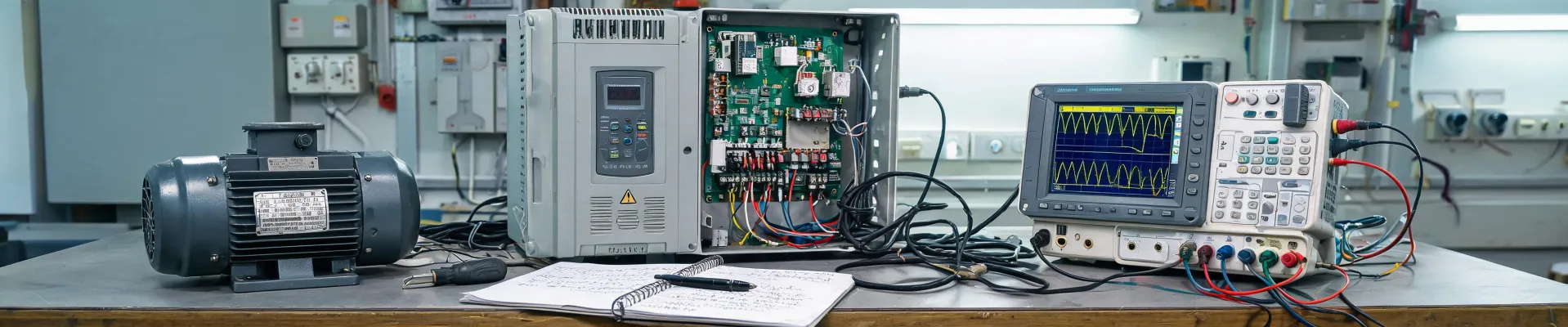
I'll say something that sounds strange for someone in procurement: I judge a component supplier more by how their engineer talks through an alarm than by how fast their quote comes back.
I'm a procurement manager at a 140-person packaging machinery company. I've managed the automation spares budget for six years—roughly $420,000 a year—and I've tracked every order in a shared cost spreadsheet. That doesn't make me a drives expert. It does make me an expert on where procurement budgets die.
ABB VFD alarm 2021: Start enable 1 missing
In Q2 2024, one of our lines stopped during a shift change. The HMI showed ABB VFD alarm 2021: start enable 1 missing. We reset the drive, tried again, and it coasted to a stop with the same alarm.
The maintenance lead was sure the drive was dead. I was ready to authorize a replacement. The supplier who had the account because of their honest pricing was quick to respond, but their answer was essentially an RMA number. They'd take the drive in for repair, charge freight both ways, and call us with a quote. I estimated $1,800 to $2,500 before we saw the line running again.
Before I approved that, I called a different ABB VFD supplier. They had been a few percent higher on almost every quote we'd compared for years. I called them because their site said 'technical support available,' and in that moment I needed someone to answer a question, not process a return.
The engineer asked a question nobody else had asked: 'Is the Start enable 1 signal wired through the safety PLC or through a simple relay?' We didn't know. According to ABB's drive fault-code documentation (ABB Drives fault code library), 2021 means the drive is not receiving the Start enable 1 signal it requires before starting. It doesn't necessarily mean the drive's power stage has failed.
With that hint, our technician found a relay in the external enable circuit that was dropping out for about 40 milliseconds during the start sequence. The VFD was fine. We replaced a $15 relay, cleared the alarm, and the drive started normally.
Here's what still bothers me: if we had followed the first supplier's repair process, we would have paid to ship, test, and possibly repair a VFD that was never broken. The only reason we avoided that was a support engineer who understood the alarm code. The quoted price didn't matter as much as the diagnostic conversation.
What that experience changed
That afternoon changed how I look at every engineered component I buy, not just VFDs. When I evaluate a controller manufacturer, I don't start with I/O count or unit price. I start with their application notes, fault-code explanations, and the quality of their technical support. The hardware is only half of the purchase.
People assume the lowest quote from a controller manufacturer is a smarter deal. Behind that assumption is the hidden belief that every unit works the same once it arrives. That's true for relays. It's not true for safety PLCs, or for any controller that has to communicate with a VFD, a safety circuit, and a PLC at the same time.
The safety PLC distributor buying guide I now use
Because safety PLCs are not ordinary stock items. A mistake there can cause a dangerous machine behavior rather than just a production stop. My procurement checklist is simple.
Step one: I send every potential distributor the same question: 'An ABB VFD is stopped with alarm 2021, start enable 1 missing. The enable circuit goes through a safety PLC. What do you check first?' The size of their catalog doesn't matter. The answer tells me whether they can actually support the equipment they sell.
Step two: I ask for the complete document package from the safety PLC manufacturer: certificate, declaration, SIL rating, and firmware revision. If the distributor treats the safety manual as optional, I remove them from the list.
Step three: I ask how returns and failures are handled before I send a PO. An out-of-box failure is rare; restocking fees are not. A distributor who explains the policy upfront costs me less than one who hides it in fine print.
Transparent pricing means showing what is not included
Many B2B suppliers think transparent pricing is just putting a low number on the quote. I think it's the opposite. Transparent pricing is telling the buyer what that number includes, and what it still doesn't cover.
Here's something vendors won't tell you: the first quote is rarely the final price for an engineered part. Shipping, restocking, document access, engineering support, and downtime all get billed somewhere. If they aren't listed on the quote, they will be explained to accounting later, usually under a line item called 'miscellaneous.'
I've learned to ask 'what's NOT included?' before asking 'what's the price?' That one question has caught more budget leaks than any spreadsheet I've built. Maybe that sounds basic. But in a B2B environment, most people are too busy comparing unit prices to finish the sentence.
But what about parts that really are spare parts?
I can already hear the objection: for a standard relay or a basic contactor, support is overkill. Fair enough. If you're ordering a part that drops into a known slot and has no firmware, no safety PLC dependencies, and no configuration steps, buy on price. I do too.
But for an ABB VFD, a safety PLC, or any controller that has to interact with a safety system, the 'drop-in' assumption is the risk. The 2021 alarm proves it. The drive looked like the failure, but the cause was outside the drive.
I can only talk about our situation: mid-size plant, in-house technician, and a maintenance culture that writes down alarm codes. If you're in a smaller shop without that internal support, you should probably pay for a service contract at the quote stage. If you're building machines by the hundreds, you need a different commercial agreement with a controller manufacturer. The point is that the quote should allow for support when the alarm appears. It should not surprise you at 2:00 AM.
I don't know why more distributors don't market this kind of support. Honestly, my best guess is that support is harder to promise than a price. A price is fixed. A support conversation depends on the question.
But if you're sourcing ABB VFDs, comparing controller manufacturers, or following a safety PLC distributor buying guide, look for the supplier that wants to know how your system is wired. Ask them how they diagnose alarm 2021. Ask what every line of their quote costs, including the line that isn't there.
Bottom line: the best industrial supplier isn't the one with the lowest unit price. It's the one who tells you upfront what is included, what is not, and what to do when the fault code appears. That kind of transparency is the only part I don't want to save money on.
The supplier who lists what is included—and what is not—wins my order, even when the first number is higher. That's not charity; that's math.

Rebecca Sloan
Rebecca Sloan is a power distribution and protection analyst specializing in circuit breakers, switchgear, contactors, fuses, surge protective devices, and coordination. She applies IEC 60947-2 breaker requirements, IEC 60269 fuse characteristics, and IEC 61643-11 tests while examining rated voltage, breaking capacity, time-current curves, selectivity, and prospective short-circuit current. She helps engineers and buyers compare protective devices against documented fault levels, installation conditions, maintenance access, and continuity priorities.