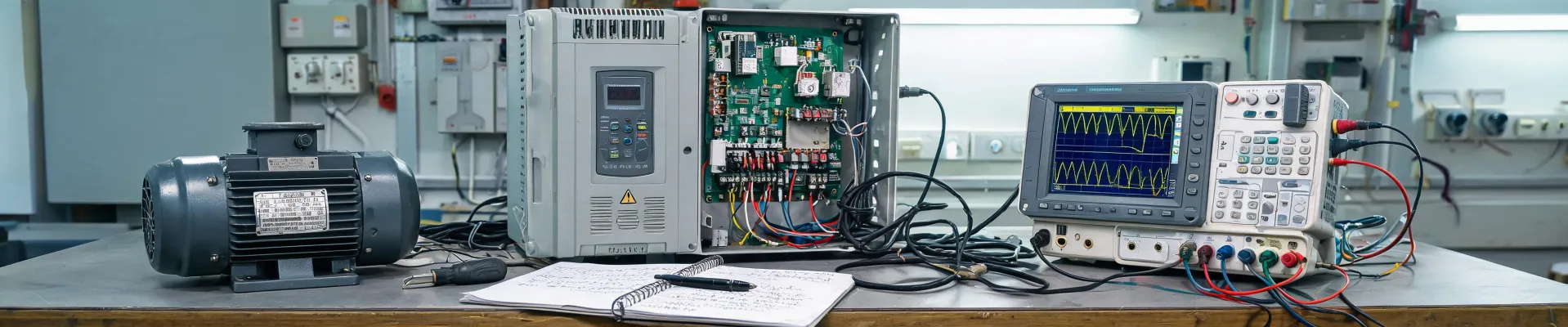
Last month, a food packaging plant called us about an ABB VFD alarm 2021. The drive wouldn't start, and the keypad showed a message that read like a verdict: Start Enable 1 Missing. The maintenance supervisor was already asking us to cross-ship a replacement drive.
We didn't. Not because we're slow about shipping. The reason was simpler: the drive almost certainly wasn't the problem—or rather, it was doing exactly what its configuration told it to do. After a 15-minute phone trace, we found a loose 24 V wire on the enable circuit and a safety relay that needed its reset sequence. No replacement drive. No return label. The line was running again before the customer finished lunch.
What Alarm 2021 Actually Tells You
Let's read the code literally. In ABB VFD alarm and fault tables, 2021 is described as Start Enable 1 Missing. The drive is not reporting an internal failure. It is not saying the IGBT stage failed or the DC bus collapsed. It is saying one specific signal was missing when the drive wanted to start.
Here's the sequence in plain terms. The VFD receives a start command from its active control source—keypad, digital input, or fieldbus. Before it energizes the motor, it checks the Start Enable 1 input. On many ACS580- and ACS880-class drives, that source is assigned through parameter group 16, often parameter 1601. If the assigned input isn't high, the drive won't start and it logs 2021.
That behavior is deliberate. The drive is simply enforcing a permission that someone designed into the machine. “Start Enable 1 missing” is not a complaint about the power stage; it's a status report from the machine's control and safety chain.
The Real Cause Is Almost Never the Drive
In the quality work I do, every returned drive with 2021 gets bench-tested and its parameter file reviewed. When I trace the story backward with the customer, the root cause usually lands in one of three places.
1. The Enable Signal Isn't Physically There
Most common by far: the input assigned as Start Enable 1 should see 24 Vdc, and it sees nothing. The physical cause can be a loose terminal, a broken wire in a cable track, a tripped control-power supply, or a relay contact with a bad connection. One customer had an auxiliary contact on a motor contactor inside the enable loop. The contactor switched fine, but its aux contact didn't close. Every time the contactor pulled in, the drive logged 2021. The VFD was healthy; it was reporting a machine fault for a component that was sitting right next to it.
2. The Parameters Don't Match the Wiring
The second cause is configuration mismatch. Someone downloads a parameter file from one machine into another, or copies settings from an old drive without checking the digital I/O map. Parameter 1601 says the enable comes from DI5. The panel was wired to DI4. The drive looks at DI5, sees nothing, and refuses to run.
This case is easy to miss because the drive may run fine on a bench with a copied parameter set. The problem only appears when the drive is connected to a control system that is behaving differently from what the parameters expect. The fix is not a new drive; it's a parameter review against the electrical drawings.
3. The Safety Circuit Hasn't Released the Drive
The third cause is the one that has grown with the adoption of safety PLCs, safety relays, and configurable safety outputs. If the drive's enable input is fed by a safety output, the drive is the last component in a chain that includes emergency stops, guard door switches, light curtains, and reset buttons. When that chain is open—door open, light curtain blocked, e-stop not reset—the safety output stays off and the drive logs 2021.
Modern safety logic often requires a manual reset after an interruption. The machine can look ready to an operator. Pressing start doesn't work. The drive says exactly what it was told: no start permission yet. Installing a replacement drive will not change that.
Why This Feels Like a New Problem
Alarm 2021 seems to show up more often than it did ten or fifteen years ago because the control architecture changed. In older panels, the PLC often withheld the start command itself; a missing start command and a denied start looked identical from the drive's point of view. Newer designs separate the command from the permission. A PLC can command a start, but a safety PLC or safety relay holds the enable line until all conditions are met. The drive is the component that announces the difference in plain text. If your troubleshooting experience was built on older relay and contactor logic, 2021 looks like a fault when it is actually a clarification.
The Cost of Misreading a 2021
Let me put a number on this. In our 2025 internal return audit, four out of five VFDs returned with 2021 in the fault history started and ran normally when we supplied the correct enable signal during testing (Source: internal return quality audit, 2025). Those no-fault returns still cost someone real money before they reached us: diagnostic labor, removal time, freight, administrative work, and quite often a rush order for a drive that wasn't needed.
Then the replacement drive is installed. It shows alarm 2021 as well—because the machine-side cause hasn't been fixed. Now there are two “suspect” drives and one machine that still doesn't run. That's how a simple circuit issue turns into an expensive mistake before downtime is even counted.
The more dangerous response is to bypass the enable input so the drive runs unconditionally. I want to be clear: using a jumper to force the enable signal during a bench test is a legitimate way to prove a VFD can run. Leaving that jumper on a live, guarded machine is not a clever workaround. It tells the drive to ignore the interlock chain that was designed to keep people safe. That is how a nuisance alarm becomes an injury.
Standards such as NFPA 79 in the US and IEC/EN 60204-1 in most other markets treat an interlock defeat as a serious matter. The alarm exists because the machine is not ready. Removing the alarm because it is inconvenient is not a maintenance procedure.
What to Check Before You Order Anything
So what should a plant do next time it sees ABB VFD alarm 2021 start enable 1 missing? Run through this sequence before calling for a replacement drive:
- Record the machine state. Was an emergency stop pressed? Was a guard door opened? Go to the alarm history and note the exact code and time.
- Find the enable source in the parameter list. Look for the start enable or run enable parameter (often group 16, parameter 1601 on many ABB generation programs). Write down which terminal must be high.
- Watch the digital input state. Most ABB control panels can display the I/O state. When you issue the start command, does the assigned enable input turn on?
- Trace upstream if it stays off. Follow that physical signal back through terminal blocks, relay contacts, safety relay outputs, and PLC outputs. Check door switches and reset buttons along the way.
- Compare the parameter file to the wiring diagram. If the enable input is high and the drive still reports 2021, the configured source probably doesn't match the actual wiring. This is common after replacements, panel rebuilds, or parameter uploads from a different machine.
- Bench-test the drive only after the machine-side checks are done. Disconnect the motor cable, recreate the enable signal for testing, and verify the power stage responds correctly. That step usually proves the VFD is not the problem.
Once that sequence clears the drive, look at the machine's safety circuit and its restart logic. If the restart interlock is a safety PLC, confirm the reset conditions have been met and the safety outputs are energized. This is routine work for any control engineer, but it often gets skipped in the rush to order parts.
How to Choose a PLC and Control Components for Wholesale
When OEM customers ask me how to choose PLCs when buying wholesale, I usually answer: don't start with the PLC. Start with the machine's stop and restart behavior. You can buy a PLC with more than enough memory and I/O, but if its logic doesn't match the safety relay or safety PLC outputs that feed drive enables, every machine will greet commissioning with the exact same 2021 alarm.
This is one reason we carry a broad control line and not just frequency converters. We work as a contactor distributor, supply safety relays and safety PLCs, and sell ABB VFDs under the same roof. That would be pointless if we merely quoted part numbers. The value is in reviewing the loop as a whole—the contactor auxiliary contacts, the safety logic output, the VFD's enable assignment. A supplier who is not willing to look at that loop is just a warehouse with an invoice template.
The Bottom Line
When your ABB VFD shows alarm 2021, don't read it as a verdict. Read it as an unfinished sentence: “I have been told to start, but the machine has not given me permission.” The rest of that sentence is somewhere in the wiring, the parameters, or the safety logic. Find it before you replace the drive. And if the only thing you changed to make the alarm go away was a jumper, you have not solved the problem—you have simply moved it into a place that doesn't display errors.
Note: Code text and parameter numbering vary by ABB drive model and firmware revision. “Start Enable 1 Missing” is the description used in many ABB drive alarm/fault tables; always confirm against the drive manual for the unit you're working on.

Rebecca Sloan
Rebecca Sloan is a power distribution and protection analyst specializing in circuit breakers, switchgear, contactors, fuses, surge protective devices, and coordination. She applies IEC 60947-2 breaker requirements, IEC 60269 fuse characteristics, and IEC 61643-11 tests while examining rated voltage, breaking capacity, time-current curves, selectivity, and prospective short-circuit current. She helps engineers and buyers compare protective devices against documented fault levels, installation conditions, maintenance access, and continuity priorities.