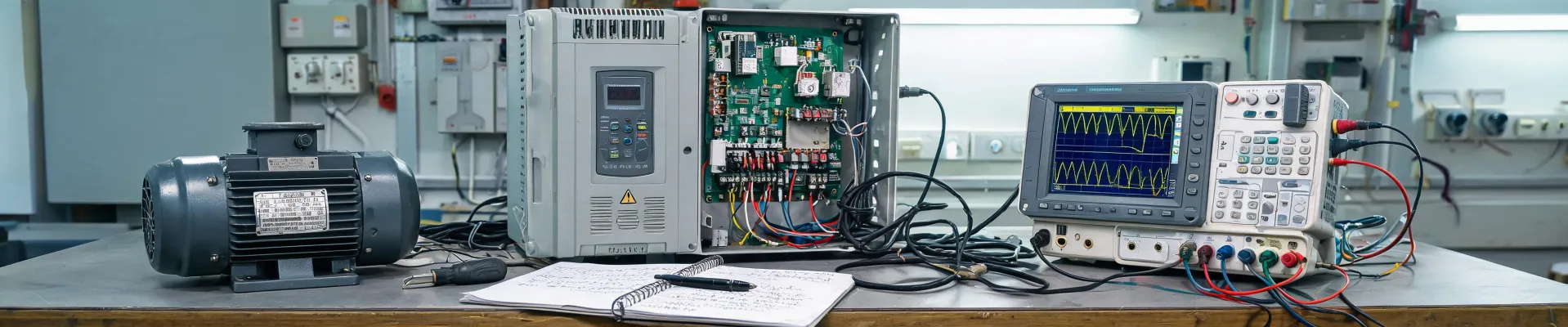
I work as a quality and brand compliance manager at an industrial controls distributor that supplies ABB VFD drives, PLCs, contactors, relays, timers, and related control components. Every order that goes out to a customer crosses my desk before it ships—200+ unique line items a year. In Q1 2024, I rejected 9% of first deliveries from our own upstream vendors because specs didn't match, documentation was incomplete, or packaging was damaged.
That background matters because I've seen what happens when buyers choose a VFD supplier based on nothing but the price sheet. Over about 150 orders, I learned a simple truth: the cheapest quote is often the most expensive one. So in this article, I'll compare two common supplier profiles—call them Supplier A and Supplier B—across three dimensions: pricing transparency, technical support and OEM range, and quality consistency. By the end, you'll know what to look for in a VFD supplier and which red flags to avoid.
Dimension One: What's Really in the Quote?
Supplier A sends an itemized quote from the start. You see the unit price, freight, packaging, documentation fees, payment terms, and lead time. Supplier B sends a bare number that looks competitive—sometimes 10-20% lower than everyone else. But the total only appears after you commit.
I've learned to ask what's NOT included before asking what's the price. That question has saved me from many surprises. A hidden handling fee here, a special export packaging charge there, a mandatory insurance premium, or a faster payment term that forces you into a discount you can't use—all these turn a “cheap” quote into a costly one.
For example, we once compared quotes on 50 ABB VFD units. Supplier B was 12% cheaper on paper. After adding freight surcharges, a separate palletization fee (which A already included), and a currency adjustment clause that didn't show up until invoice, B ended up 8% higher than A. Not better than A—better than the original quote, but worse than the total.
Seems cheaper. Usually isn't.
Transparency isn't about being the lowest-priced supplier. It's about being able to calculate the real landed cost. If a supplier can't or won't list all charges up front, you can't do a proper comparison. And in my experience, that's usually the sign of a transaction-based vendor, not a relationship-based partner.
What to look for: a quote that itemizes every line, a clear incoterm, a written explanation of additional costs (if any), and no “we'll clarify later” language. That's the foundation of trust.
Dimension Two: Support and Product Range After the Sale
From my side of the quality desk, I see the consequences of weak support long before the customer calls us. Supplier A has application engineers and product specialists who can answer ABB drive troubleshooting questions—like what common fault codes mean, or how to configure a drive for a specific motor. They can also recommend the right ABB VFD series, whether you need an ACS580 for basic variable torque applications or an ACS880 for more demanding process control.
Just as important: Supplier A can supply the rest of the control chain from one source. When you order ABB VFD drives, you can also order the matching contactor OEM parts, PLC OEM components, relays, timers, and safety PLCs. That's a big deal for OEM builders because it simplifies your BOM and gives you one point of reference for compatibility.
Supplier B, by contrast, sells boxes. They might not know if a specific contactor has the right coil voltage or if a PLC output module communicates with the drive. They'll often say “it's compatible” without providing documentation or test data. I've seen “compatible” parts that had the right electrical ratings but the wrong physical dimensions—a 2mm difference that made the whole panel layout unusable.
I don't have hard data on how many hours of field troubleshooting come from mismatched components. But based on our support calls, my sense is that a huge percentage of “installation issues” trace back to the wrong peripheral being paired with the drive. The best way to avoid that is to buy from a supplier who understands the ABB ecosystem, not just one who stocks a few SKUs.
What to look for: a supplier who asks about your application, offers technical documentation, can explain fault codes, and can source ABB-compatible control components—contactors, PLCs, timers, safety relays—from the same catalog. That saves you procurement time and integration risk.
Dimension Three: Quality Consistency at the Receiving Dock
This is where my job comes in. A beautiful website and a great sales pitch don't tell you how a supplier handles tolerances, packing, and traceability. What matters is what arrives at your dock—and how often it makes you reject a shipment.
Supplier A provides certificates of conformance, batch-level traceability, and clear part markings. They're open to a pre-shipment inspection or a third-party audit. They package for transit properly, using ESD-safe materials where needed and enough cushioning for heavy drive units.
Supplier B usually can't produce a clear batch record. They may resist third-party inspections and say “this is how we always do it.” And their packaging often tells the real story—drives wrapped in thin plastic, cardboard boxes crushed, missing manuals, unreadable nameplates. I've seen PCB-level damage from static because parts weren't shipped in conductive packaging.
I once assumed that “same specifications” meant identical quality, and accepted a low-bid order without a pre-shipment inspection. That was a mistake. The batch had inconsistent terminal torque specs, and several units had obviously been repackaged after being removed from their original packaging. That failure caused an $18,000 rework and delayed our line by three weeks. Now every contract includes tolerance requirements, inspection rights, and documentation standards.
For ABB VFD drives specifically, consistency also has a regulatory dimension. Adjustable speed drives must meet requirements such as IEC 61800-3 for EMC and, depending on the market, UL listing or CE marking. A supplier that can't verify those standards is a liability. Even minor deviations in component marking can cause panel builders to fail their own inspections.
What to look for: a supplier who can show you their quality process, offers serial numbers and lot traceability, uses proper packaging, and accepts reasonable inspection terms. If they treat inspection as an accusation rather than a standard practice, consider that a red flag.
So: Which Supplier Should You Choose?
The honest answer depends on your application.
- For OEM projects or critical replacements: Choose a Supplier A model. You'll pay a modest premium, but you get an itemized quote, engineering support, a matched set of ABB VFD drives and control components, and traceable quality. That's worth it when downtime is expensive.
- For non-critical, one-off purchases: A low-bid supplier might be acceptable if you have internal electrical expertise and can verify quality yourself. But still ask for itemized pricing and a certificate of conformance. If they can't provide either, even a one-off isn't worth the risk.
- For mixed control panels: Don't source your ABB VFD from one place and your contactor OEM or PLC OEM parts from another unknown supplier. Mismatched documentation and tolerance variations will eventually be your problem. Buy the ecosystem from someone who can speak to it.
I'll end with what I tell every new buyer: the supplier who lists all fees upfront—even if the total looks higher—usually costs less in the end.
Transparent numbers build trust. Trust prevents rework.
That's what to look for in a VFD supplier. Not a perfect price. A truthful quote, real support, and consistent quality. Everything else is just noise.

Rebecca Sloan
Rebecca Sloan is a power distribution and protection analyst specializing in circuit breakers, switchgear, contactors, fuses, surge protective devices, and coordination. She applies IEC 60947-2 breaker requirements, IEC 60269 fuse characteristics, and IEC 61643-11 tests while examining rated voltage, breaking capacity, time-current curves, selectivity, and prospective short-circuit current. She helps engineers and buyers compare protective devices against documented fault levels, installation conditions, maintenance access, and continuity priorities.