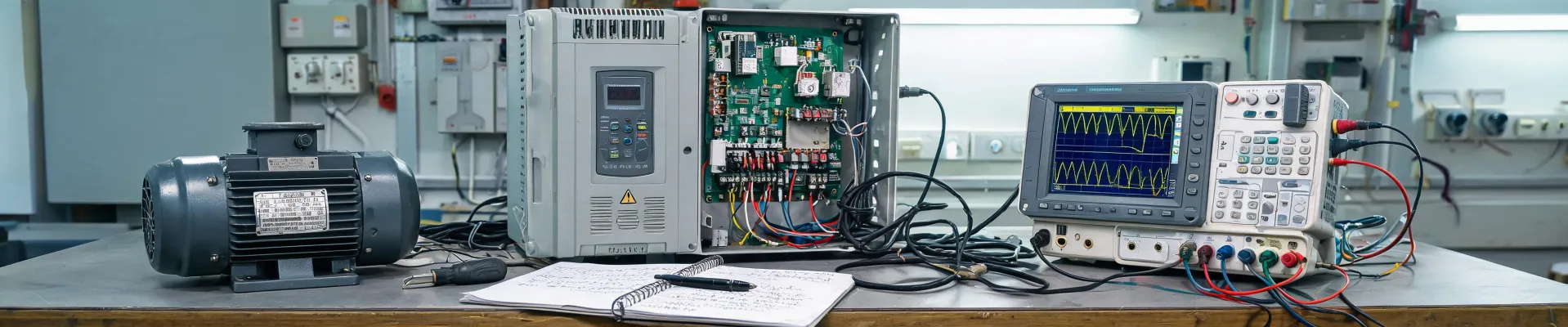
Here's the question I get almost daily: "Which ABB VFD should I buy?"
It's the wrong question. I didn't always think so.
When I first started specifying ABB VFD drives and control components for B2B customers in 2017, I assumed the whole job was picking a model number and getting a volume discount. I was wrong — in ways that cost real money. Mine and my customers'.
The real problem isn't which ABB VFD. It's what the drive has to handle, where it's going, and what it's talking to. Skip those questions, and no quote — wholesale or otherwise — will save you.
What I Initially Got Wrong
When I started, I thought a VFD was specified by motor horsepower. Customer says "20 HP motor," I quote a 20 HP drive. Simple. Three budget overruns later, I learned that horsepower is just the conversation starter. The real VFD specification work happens in the details nobody asks about: full-load current, duty profile, ambient temperature, enclosure, control voltage.
One early order still stands out. A customer needed a drive for a fan motor. I quoted the obvious model, it shipped, and everything looked fine on paper. Except the motor nameplate showed a full-load current above the drive's continuous output rating. The ABB VFD drive tripped on overload twice in the first week of commissioning. We replaced it, ate the freight, and sent the correct unit. (Which, honestly, was embarrassing.)
That's when I learned — the hard way — that horsepower is an approximation. Current is a spec.
The Deep Causes: Why Specs Go Wrong
The surface problem looks like "wrong drive." But that's the symptom. Here's what actually causes it.
Cause 1: We spec the part, not the application
We buy components like they exist in isolation. They don't. An ABB VFD is part of a system: motor, cabling, enclosure, relays, contactors, controller, and power supply. A drive's data sheet is meaningless without the context of that system.
In September 2022, I ordered 32 relays for a control panel build alongside several VFDs. We were rushing (ugh), and I approved the relay submittal without double-checking coil voltage against the panel drawings. Thirty-two relays with 24 VDC coils. The panel ran on 120 VAC. Every single one was wrong.
That mistake cost $450 in useless parts, $880 in expedited replacements, and a 3-day production delay. Control relays and contactors are rated under IEC 60947 — coil voltage, contact ratings, utilization category. Skip those details to save an hour, and you're gambling with the whole panel.
Cause 2: The environment is part of the spec, whether we write it down or not
Another pattern: we spec from electrical data and ignore the physical environment. IP rating matters. Ambient temperature matters. Altitude matters.
I still kick myself over a 2022 install where the drives went into a non-ventilated cabinet in a facility that regularly hit 55°C. The drives derated themselves and tripped the line repeatedly. Nobody flagged the maximum ambient temperature on the spec sheet. What should've been a $50 ventilation upgrade became a $2,700 field retrofit and an angry client.
According to ABB's technical documentation, output current derates above 40°C for most drive series — and the curve gets steeper in enclosed cabinets. The broader requirements live in IEC 61800, the standard family for power drive systems. It's all published. It's all available. But nobody reads it when the procurement deadline is breathing down your neck.
Cause 3: Wholesale price thinking is the real trap
When a buyer asks for a "controller wholesale cost guide," they usually mean: what's the cheapest unit price for relays, contactors, and drives? I used to think that way too. But the lowest unit price on a component with the wrong rating isn't a bargain. It's deferred rework.
Everyone told me to verify relay coil voltage before ordering. I didn't listen. That's what $450 of scrap taught me.
I don't have hard data on industry-wide mis-specification rates, but based on seven years of orders, my sense is that 12–15% of first-time VFD orders have at least one spec error serious enough to affect installation or operation. That percentage is the hidden cost of price-driven buying.
Cause 4: Spec quality is brand quality
When a drive fails on the floor, the customer doesn't say "the VFD failed." They say "the solution we bought failed." You can't separate component quality from spec quality in the customer's mind.
When I switched from confirming model numbers to actually reviewing application specs, client feedback changed. One customer told me I was the first distributor who asked to see the motor nameplate. That's not a compliment to me. It's an indictment of how drives get sold.
What It Actually Costs
Here are real numbers from my own mistakes:
- The relay coil voltage error (September 2022): $450 in unusable parts + $880 in expedited replacements + a 3-day production delay.
- The wrong current rating (2017): return freight, restocking, and re-engineering — roughly $890, plus a week of schedule delay.
- The IP21 drive for a washdown area (2021): caught before shipping, but the resubmittal and re-specification cost two weeks of engineering time.
- The 55°C cabinet (2022): a $2,700 field retrofit that should've been a $50 line item on the spec sheet.
Those four alone add up to over $5,000. Across all 23 documented mistakes, the total is roughly $41,000. (And that's one person, at one distributor, in seven years.)
Mis-specification costs are like an iceberg. The visible part is what you write off — the scrapped relays, the return freight. The hidden part is the customer's downtime, your engineer's troubleshooting hours, the expedited shipping premium, and the quiet erosion of trust. The expedite fee stings. The phone call from a plant manager with a stopped line stings a lot more.
The hardest cost to measure is credibility. A customer who watches you catch problems before shipping trusts you. A customer who experiences your errors associates your name with downtime. After we cleaned up our spec process, repeat order rates went up — not because our prices changed, but because our questions changed.
The Checklist That Turned It Around
In Q1 2024, after the third rejected submittal in a row, I created a pre-quote checklist for every ABB VFD and control component order. In the 18 months since, it's caught 47 potential errors that would have shipped.
- Motor nameplate data — full-load amps, voltage, RPM. Not just horsepower.
- Duty profile — variable torque (fans, pumps) or constant torque (conveyors)? ABB catalogs list separate normal-duty and heavy-duty current ratings; make sure you're quoting the right column.
- Environment — ambient temperature, altitude, enclosure IP rating, washdown or dust exposure.
- Control voltage — relay coils, contactor coils, and controller I/O must match the panel drawings. (I learned this one the $450 way.)
- Communications protocol — Modbus RTU, Ethernet/IP, or PROFIBUS? Confirm before quoting.
- The full BOM, not just the drive — an "almost right" relay costs more in downtime than a correctly rated one costs in dollars.
That's it. Nothing fancy. But it changed our error rate, and it changed how customers see us.
The Short Version
The solution isn't complicated: know the application before you quote the part. The deeper shift is moving from price-driven purchasing to system-driven purchasing.
Spec quality is brand quality. When you specify carefully, the drive works, the customer's line keeps running, and your reputation compounds. When you cut corners on spec, you don't save money — you just move the cost into rework, delays, and damaged trust.
I still kick myself over those 32 relays. If I'd just verified the coil voltage, we'd have saved the $450 and the embarrassment. Now the rule is simple: no spec sheet, no quote. It's cost us a few impatient buyers who wanted a number fast. It's also earned us the buyers who understand that the cheapest ABB VFD quote is not the real cost of ownership.

Rebecca Sloan
Rebecca Sloan is a power distribution and protection analyst specializing in circuit breakers, switchgear, contactors, fuses, surge protective devices, and coordination. She applies IEC 60947-2 breaker requirements, IEC 60269 fuse characteristics, and IEC 61643-11 tests while examining rated voltage, breaking capacity, time-current curves, selectivity, and prospective short-circuit current. She helps engineers and buyers compare protective devices against documented fault levels, installation conditions, maintenance access, and continuity priorities.