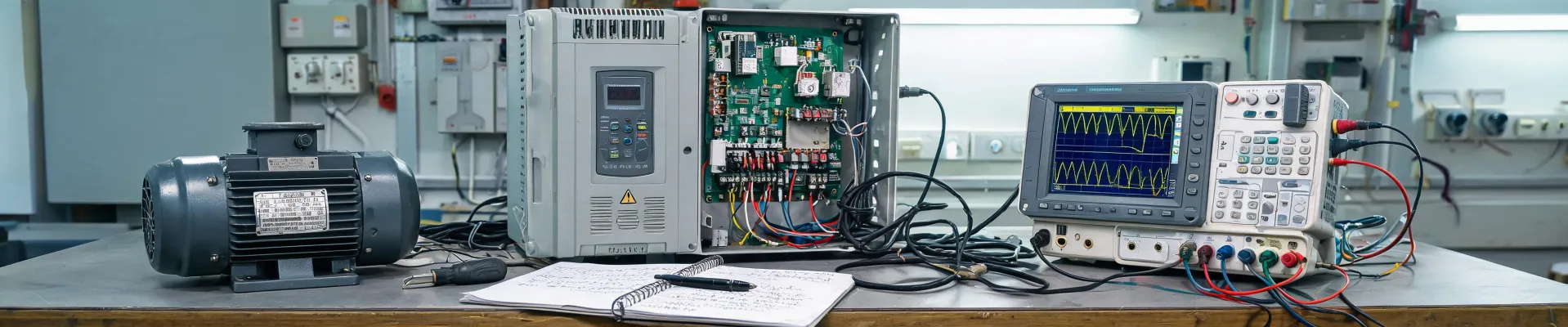
I'll say something that might irritate a few maintenance managers: the ABB VFD fault code on the display is not the problem costing you production. Your supplier strategy is.
I coordinate emergency parts and technical support for an industrial controls distributor that works primarily with ABB VFDs. When a line goes down at 11 p.m., I'm usually one of the first calls. I've spent the last several years handling breakdowns where the clock was already ticking before I picked up the phone. After enough of those calls, I've changed my mind about how plants should approach spares, fault codes, and sourcing decisions. This article explains why.
ABB VFD Fault Codes: The Starting Line, Not the Finish Line
Look up abb vfd fault codes and you'll get a long list of what each code means. Overcurrent. Undervoltage. Overtemperature. The manual describes the conditions that triggered the trip. Fair enough. But a fault code is a symptom, not a diagnosis. The drive is telling you it saw something abnormal. It is not telling you why the abnormal thing happened.
In March 2024, a packaging plant called about a drive that kept tripping during acceleration. The maintenance lead had already ordered a replacement drive from an online surplus seller. The line restart deadline was 36 hours away, and he wanted to know if the new drive would arrive in time. My first question wasn't about shipping. It was: what does the motor actually drive? It drives a conveyor that feeds cartons into a wrap station. Then: has anyone checked the conveyor mechanically? Silence. It turned out a bearing on an idler roller was failing, and the drive was tripping because the motor was being asked to accelerate a load that was physically seizing. Replacing the VFD would not have solved the problem. The fault code was the whistleblower, not the culprit.
That story repeats, in different forms, more often than I expected. What makes it painful is not the lack of technical information. It's that the person making the decision was under pressure and reached for the easiest explanation. A fault code list does not give context. It rarely tells you what changed since the last good run. It doesn't know that this is the third trip this week, or that the motor cable was replaced last month, or that the line uses a bypass contactor that has been chattering. That context is what turns a fault code into a repair plan.
You can extract some of that context from the drive itself. The event log, the fault history, the recorded values at the time of the trip — these tell a much better story than the code alone. But I rarely see maintenance teams pull that data before they call a supplier. And when they do skip it, they usually pay for it in expedited shipping and return fees.
Contactor Sourcing: What Changes When You're in a Hurry
Let me admit a bias. Early in this job, I assumed a contactor was a contactor. Same coil voltage, same number of poles, same frame size—what else could matter? A few failed emergency purchases taught me otherwise. Contactor sourcing becomes a completely different exercise during a shutdown.
A contactor that works alongside an ABB VFD installation is part of a chain. It has to suit the application's utilization category (think AC-3 for motor starting, not AC-1 for resistive heating, to reference IEC 60947-4-1). Its coil has to be compatible with the control circuit. The auxiliary contacts have to match the logic the panel builder intended. The thermal overload has to coordinate with the contactor and the motor. When you're in a hurry, these details get treated as optional. They are not optional.
What I've learned is that good contactor sourcing starts with the part number printed on the side of the device, not with a keyword search. Online marketplaces are convenient, but they usually sell you a substitute, not a cross-reference. The substitute might bolt into the same location. It might have the same current rating. But if it has one fewer auxiliary contact, or a coil with a different inrush signature, the machine may fail in a way that looks like a completely new fault. (Note to self: always ask for a photo of the existing nameplate before promising a part will work.)
I've also stopped recommending the cheapest rush option after a customer bought an online substitute to save roughly $60. The contactor had the same current rating and the same coil voltage—but one fewer auxiliary contact than the original. The control circuit never received its "contactor closed" confirmation, so the machine refused to start. An electrician spent four hours tracing a problem that was obvious from the model code. The correct part arrived overnight and worked on the first try. The $60 saving became an expensive lesson.
Timer Compliance Requirements: The Least Popular Topic in an Emergency
Timer compliance requirements may be the least loved words in industrial maintenance. Everyone accepts fault codes. Everyone understands why contactor sourcing matters. But the moment you mention regulations, certificates, and documentation, I can hear the silence on the other end of the call.
Here's something many parts distributors won't tell you when you're in a rush: a timer is not always just a timer. Timing relays often sit in interlock circuits or control circuits that support machine functions. Some of those functions have documented performance requirements. If you replace a timer based only on time range and pinout, you may fix the immediate fault and create a documentation problem for the next machine acceptance, commissioning review, or safety validation.
I'm not saying every failed timer in every panel is a safety-related component. Most are ordinary control devices. But when you're buying under pressure, you rarely know which circuits the timer is actually part of. I've seen a customer install an aftermarket timer with the correct socket and correct time range, only to discover during a later review that the original component had been listed in the machine's technical file. The replacement had no matching declaration. The machine ran fine. The paperwork did not.
What most people don't realize is that the certificate and the declaration are part of the spare part. They can be as important as the relay itself when your customer or an inspector asks for evidence that the machine still meets its design specification. This is not a reason to panic. It is a reason to slow down long enough to ask one question before you order: is this timer part of a documented safety function, or is it a general-purpose control timer? That single question has saved our customers more audit pain than any expedited shipping option ever has.
What a VFD Supplier Should Actually Provide
So what should you look for in a vfd supplier? Not just inventory. Inventory matters, but the real value shows up when the problem is unclear.
A distributor that only processes orders will ask what you want and send a quote. A distributor that understands ABB VFDs and related control components will ask questions like: Did you pull the fault history? What were the values before the trip? Does the replacement need to match the existing configuration, or can we offer the latest hardware revision? Can you send a photo of the contactor nameplate? Do you know whether this timer is in a safety circuit?
These questions sound annoying when production is stopped. They are also the reason some of our emergency calls end in one shipment while others end in three. The fastest fix is not always the one with the shortest delivery time. Sometimes it is the one that avoids a second trip because the wrong part was ordered.
When I'd Tell You to Ignore This Entire Article
You might be expecting me to say that every plant needs a relationship with a premium distributor, a stocked spare cabinet, and a 24/7 support line. I'm not going to say that, because it isn't true.
If your facility has in-house engineers who can read fault logs, access to a well-stocked industrial supplier, and a process that tolerates a few hours of downtime, you probably don't need the level of support I'm describing. For many smaller operations, buying locally and keeping a few basic spares on the shelf is the right, honest answer. It is not a weakness to be self-sufficient.
You're in the other category if one hour of downtime hurts more than the annual cost of a distributor relationship. If every breakdown creates a scramble because no one knows the part numbers or configuration of the installed equipment. If your last three emergencies were actually misdiagnoses rather than component failures. In those situations, the supplier you choose before the emergency matters more than any fault code table you can find online.
Here's my final position: Treat abb vfd fault codes as the first clue, not the complete answer. Be deliberate about contactor sourcing and timer compliance requirements. And choose a vfd supplier that can ask you a smart question at the moment you need one most. That's not a sales pitch. It's the conclusion I've come to after watching too many lines sit idle while someone waited for a part that was never the actual problem.

Rebecca Sloan
Rebecca Sloan is a power distribution and protection analyst specializing in circuit breakers, switchgear, contactors, fuses, surge protective devices, and coordination. She applies IEC 60947-2 breaker requirements, IEC 60269 fuse characteristics, and IEC 61643-11 tests while examining rated voltage, breaking capacity, time-current curves, selectivity, and prospective short-circuit current. She helps engineers and buyers compare protective devices against documented fault levels, installation conditions, maintenance access, and continuity priorities.