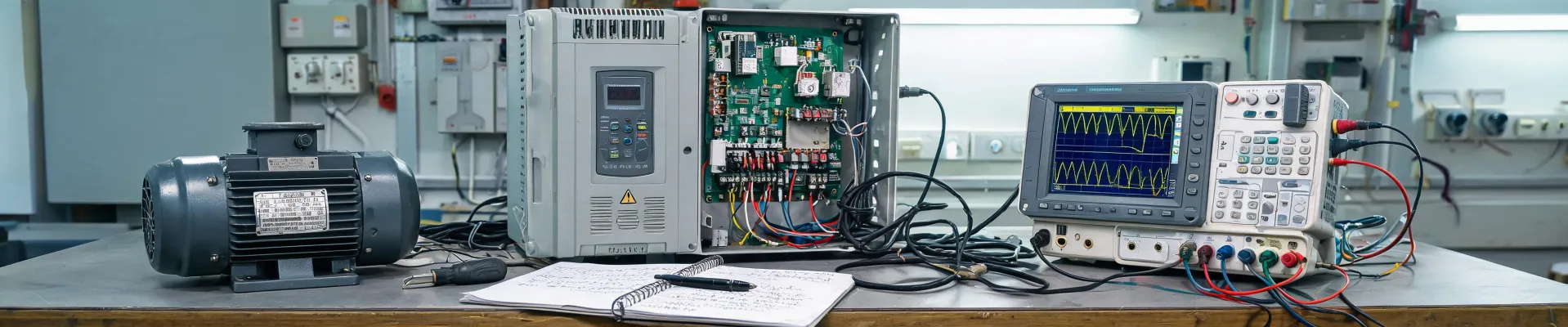
The Lowest ABB VFD Quote Isn't a Deal. It's a Warning Sign.
I need to say something that might irritate a few people in procurement: the cheapest ABB VFD quote you receive is almost never the one you should take. Not because I'm loyal to a specific vendor. Not because I get a kickback. Because I've watched "savings" turn into headaches too many times—including once when it cost me $8,400 and nearly a client.
I've been handling electrical equipment orders for nine years now. In that time, I've made some genuinely expensive mistakes. The kind you document specifically so other people don't repeat them. Today I maintain our team's vendor checklist—and I want to walk through why the price tag on an ABB VFD, whether it's an ACH550 or a newer ACS series, tells you maybe 40% of the actual story. Consider this a VFD wholesale cost guide written by someone who got it wrong first.
The $8,400 Lesson I Learned in 2017
In my first year managing VFD orders, I made the classic rookie mistake: I assumed the lowest quote on identical specs meant the best deal. We needed 12 ABB ACH550 drives for a pump station retrofit. I found a "wholesale distributor" online offering them 18% below our regular channel. Specs matched. Lead time was shorter. I approved it without a second thought.
The drives arrived. They looked right. Sounded right on startup. Then four of them threw F0021 fault codes within two weeks. That's a current measurement fault—not something you want in a pump application handling wastewater.
I called ABB technical support. That's when I learned the drives weren't actually their units. Serial numbers didn't verify. The firmware wasn't genuine. Someone had refurbished older units, slapped on new faceplates, and shipped them as new.
Here's the damage breakdown:
- Replacement cost for all 12 units: $8,400 above what we'd "saved"
- Two-week project delay
- Emergency shipping: $680 extra
- Time spent on the claim: roughly 30 hours of my life I'm not getting back
The procurement manager was forgiving. The client was less so. We kept the account, but barely. That's the cost of chasing the cheapest quote.
The Causation Runs Backwards
Here's something that took me years to internalize: people assume high prices cause better quality. The reality is closer to the opposite—vendors who actually deliver quality can charge more and still earn repeat business. The causation runs the other way.
When you see an ABB VFD listed significantly below market rate from a non-authorized source, you're not looking at a steal. You're looking at one of a few things:
- Grey-market units with no warranty coverage
- Counterfeit or refurbished-as-new drives
- Stock being liquidated because it's obsolete or has a known defect
- Units someone misordered and is now dumping
I should add that this isn't unique to ABB drives. I've seen the same pattern across the controller catalog—relays, contactors, PLC modules, all of it. But VFDs are especially vulnerable because they're high-value, compact, and easy to counterfeit convincingly. According to ABB's official documentation (abb.com), genuine drives carry serial numbers verifiable through their support portal—something counterfeiters either can't replicate or don't bother trying to.
Let's Do the Math
Say you're sourcing ABB VFD drives in bulk. You find a supplier quoting 20% below your regular distributor. On a $15,000 order, that's $3,000 in "savings." Seems obvious, right?
Now run the risk-adjusted numbers. In my experience—and I've tracked this across roughly 200 orders since 2018—about 1 in 5 non-authorized suppliers will deliver something that doesn't perform as specified. Could be counterfeit units, grey-market stock with no support, or simply wrong firmware versions. So on a $15,000 order, your expected value calculation looks like this:
- Best case (80% probability): you save $3,000
- Problem case (20% probability): you spend $3,000 extra on replacements + $1,500 in delays + labor hours + credibility damage
Expected value: $3,000 × 0.8 – $4,500 × 0.2 = $2,400 – $900 = $1,500 in expected savings. Still positive, right?
Now adjust for the fact that the problem case usually has a tail. It isn't just replacements. It's production stops while you sort it out. It's the client asking why your gear failed. It's the procurement review meeting that shouldn't have needed to happen. That tail can easily hit $10,000 or more on a project with real deadlines. Suddenly your $3,000 "savings" is a $7,000 loss.
And this doesn't even account for the VFD's actual operating cost. A genuine ABB drive running a 75 HP motor at 6,000 hours per year with a 15% speed reduction saves roughly $4,200–$6,800 annually in energy costs based on ABB's own energy calculators. A counterfeit unit with inferior power electronics? Those savings disappear fast when the drive runs at degraded efficiency or fails entirely and shuts down your motor. That's a whole separate nightmare I'll save for another post.
"But Our Budget Is Tight"
I hear this one a lot. I get it. Budgets are real. Capital cycles are real. When you're facing a spending freeze or a project that's already over-budget, saving 15% on the equipment line item feels like the responsible choice.
But here's the thing: the cheapest option and the most affordable option are not the same thing.
Most of the VFD failures I've dealt with weren't the drives' fault. They were installation mistakes, incorrect parameter settings, or mismatched motor-drive pairings. ABB provides one of the best parameter documentation sets in the industry—no argument there. But you know who doesn't help you navigate it? The grey-market reseller who won't return your calls after the invoice clears.
When you buy through an authorized channel—or at least a distributor who actually provides technical support—you're not just buying hardware. You're buying access to expertise. You're buying someone who can look at your application and tell you whether the ACH550 you selected is actually right for a 6-pulse system, or whether you need a 12-pulse drive to handle your harmonics. And they'll pick up the phone six months later when something behaves unexpectedly. That's not a cost. That's insurance.
What I Actually Check Before Approving an ABB VFD Order
After the $8,400 incident, I built a checklist. Here's the short version:
- Verify the supplier's authorization status. Not all "ABB distributors" are created equal. Some are just scrappy resellers. Ask directly.
- Check serial numbers before installation. ABB's portal makes this easy. Do it during receiving, not after the drives are on a panel.
- Confirm the exact model number, including suffix codes. An ACH550-01-XXX is not the same as an ACH550-01-XXX-4. And no, your purchasing system won't always catch it.
- Get the firmware version in writing. Some drives require specific firmware for specific applications. "Standard" means different things to different people.
- Ask about technical support in writing. Will they help you configure the drive? Will they troubleshoot if something goes wrong? Get it in the quote.
We've caught 47 potential issues using this list over the past 18 months. Some were minor—wrong accessory, mislabeled voltage rating. A few would have been genuinely costly. All of them were avoidable with a five-minute check.
Your Call
Look, I'm not saying you should always buy the most expensive ABB VFD on the market. That's not value—that's just convenience shopping. I'm saying the lowest quote deserves the most scrutiny, not the least.
Run the real numbers. Factor in the hidden costs. Ask the supplier hard questions and watch how they respond. And remember: if a deal looks too good to be true on ABB VFD pricing, it almost certainly is.
If you want to avoid the mistakes I made, start with a checklist. It's cheaper than tuition.

Kwame Boateng
Kwame Boateng is a transformer and power-conversion analyst specializing in distribution transformers, power supplies, inverters, and network integration. He uses IEC 60076 test data for transformer ratio, impedance, losses, and temperature rise, and IEC 62477-1 safety requirements for converter insulation and thermal boundaries while separately comparing harmonics and efficiency curves. He helps engineers and sourcing teams compare equipment against duty profiles, environmental limits, short-circuit behavior, lifecycle energy cost, and service requirements.