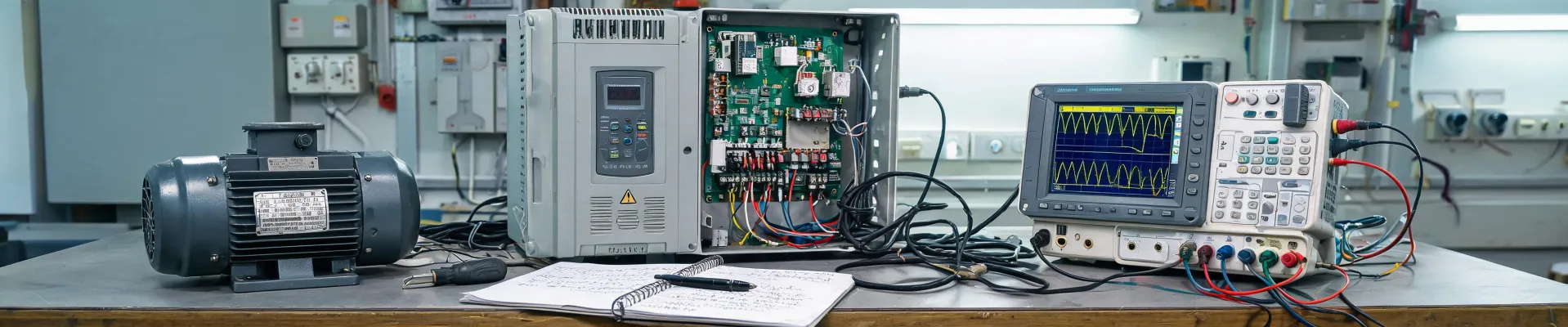
I'm going to say something that might not sit well with cost-cutting procurement teams: when you source ABB VFDs and related control components, the cheapest quote is often the most expensive decision you'll ever make.
Let me establish where this comes from. I'm a quality and brand compliance manager at an industrial controls supply company. I review every delivery before it reaches customers—roughly 200+ line items per year, maybe 220, I'd have to check the dashboard. Everything from 110 kW VFDs down to panel relays and DIN-rail timers. In our most recent quarterly audit, I rejected 6.5% of first deliveries. Not because anyone was selling counterfeits. Not because the vendors were dishonest. But because the specification on paper didn't match what actually arrived.
There's a pattern behind those rejections. Every single one happened because someone optimized for price instead of certainty.
My position is simple: in industrial automation, time certainty is a value creator, not a cost center. Paying a fair premium for guaranteed, verifiable, correct-in-time delivery beats any "deal" that shows up wrong, shows up late, or shows up with documentation that doesn't match the hardware. Here's why I hold that opinion.
The ABB VFD wiring diagram gap
Let's start with the most common scenario I see: an ABB VFD installed using the wrong wiring diagram.
I didn't fully understand how much this matters until a food-processing plant called us in early 2024. Their ACS580 on a wash-down conveyor died over the weekend. A purchasing agent had found a "compatible" drive from a cheaper reseller—same model, same power rating, about $260 less than our quote. It arrived Monday morning. The wiring diagram inside the box was for an older hardware revision, which moved the control terminal assignments slightly. Not dramatically. Just enough that the 24 V digital input was landed two terminals off.
At 9 AM, the electrician followed the diagram and got random jog commands on power-up. By noon, the plant had traced the problem to the terminal layout. By 2 PM, they called us, we cross-shipped a verified unit with the correct ABB VFD wiring diagram, and the line was running the next morning. In between, they lost a full production shift, paid overtime for two electricians, and scrapped about $1,800 of partially processed product.
The $260 "savings" ended up costing somewhere around $6,000. Nobody puts that on a spreadsheet, which bugs me. The purchase price gets tracked. The cost of being wrong doesn't.
This was true years ago, back when VFD hardware revisions changed slowly and any diagram was close enough. Today, firmware revision cycles are shorter, parameter menus get reorganized, and I/O layouts shift between hardware versions. "Close enough" is what gets you cross-wired at 2 AM.
Bulk timers and relays: consistency is the real specification
Now let's talk about the other end of the spectrum—buying relays and timers in bulk.
When an OEM panel builder orders 2,000 relays or 5,000 timers, they're not just buying components. They're staking an entire production run on the consistency of every single unit in the batch. And consistency, not unit price, is the real specification.
Here's what I check when choosing relays for wholesale orders:
- Coil voltage and type. A DC-coil relay can't be dropped into an AC-coil position. Holding current, minimum pickup voltage, and heat dissipation all behave differently.
- Contact rating under inrush, not just nominal. An 8 A contact can look fine for a circuit that draws 4 A steady-state. Then someone energizes a capacitor bank and the inrush welds the contacts shut. I've seen it happen more than once.
- Repeat accuracy for timers. A datasheet might say "±2% repeat accuracy," which sounds fine. On a 100-second delay, that's ±2 seconds. In an irrigation cycle, that's the difference between a well-watered field and a flooded one.
I got burned on this in my first year in the role. Like most beginners, I approved a batch of time-delay relays based purely on datasheet comparison. Learned that lesson when a customer reported that 40% of their boards had timing drift once the panel heated up. The units weren't counterfeit—they were just built to a tolerance that didn't fit the application. We reworked the entire batch at our cost, and I haven't trusted a datasheet alone since.
That same mindset applies to bulk timer sourcing. In 2023, a panel builder for irrigation systems came to us after their previous supplier let them down: a batch of 1,500 timers drifted when the control panels sat in direct sunlight—internal panel temperature around 55°C. Valves stayed open minutes too long, waterlogged parts of a golf course, and crews had to be dispatched to manually override the controllers. Fixing that cost them somewhere around seven times the "discount" on the timers—or rather, the rework and field service cost seven times the savings. We now run sample temperature-sweep checks on any timer batch above 500 units. It adds a week to lead time and a small per-unit cost. It also means our customers get timers that behave the same on unit 1 and unit 4,999.
Safety PLC sourcing: certified certainty is non-negotiable
If relays and timers are about process consistency, safety PLC sourcing is about a different category of risk entirely. And this is where I get the most pushback on the "pay for certainty" message—because someone will always say, "the certifications are basically the same, why pay more?"
Comparable is not identical. Under IEC 61508, a safety PLC's SIL rating is only meaningful if a certified body has actually assessed that specific hardware and firmware version. And that certification only covers what it covers. If a vendor ships a unit with a different firmware build, or a document package that references a different product line, the certification claim is essentially void for that item.
In a 2024 project, we helped a machinery builder source safety PLCs for a packaging line. The competing quote was about 15% lower. But the vendor couldn't produce a batch-level EU Declaration of Conformity that referenced the correct harmonized standards. They offered a "similar" declaration from a different product line as proof. For a safety component, that's not a paperwork detail—that's a commissioning failure waiting to happen.
I want to be careful not to overstate the point. In some markets, enforcement is more relaxed. In others, an inspector will check whether the declaration of conformity actually covers the delivered batch. If it doesn't, that machine can't legally start. So the timeline impact of "close enough certification" isn't measured in hours—it's measured in days or weeks of stopped commissioning.
"But our current supplier has been fine"
I know exactly what you're thinking: "Our supplier has been okay for years, why would we change?" And honestly, if you've been buying the same simple relay, in the same panel, at the same voltage, for years, and it works—then don't change. This argument isn't for you.
The belief I want to push back on is that "in stock" and "cheaper" are the only two variables that matter. That way of thinking comes from an era when components had long revision cycles, supply chains were straightforward, and certification requirements were simpler. That's changed. In 2026, hardware revisions turn over fast, certification frameworks get updated, and "in stock" can simply mean "somewhere in a warehouse, unverified."
So my recommendation isn't "always buy the premium option." It's "when you're under deadline pressure, buy the option that removes uncertainty." Verified specifications. Correct documentation. Confirmed lead times. A supplier who answers the question "will this be right and will it be on time?" with a commitment, not a hedge.
Bottom line
Here's my position, and I won't soften it: the price on the quote is not the price you pay for an ABB VFD, a bulk timer order, a safety PLC, or a wholesale relay purchase.
The cost that never appears on the purchase order is the stopped line, the late delivery, the rework that eats your margin, the safety audit that uncovers missing documentation. That cost is real, and it's usually larger than the premium you'd have paid for certainty.
The real question isn't "can I afford to pay more for guaranteed delivery?" It's "can I afford the alternative?"
Trust me on this one. I've been the person holding the rejection stamp for the better part of a decade. I still haven't seen a $200 savings on a component cover the cost of the mess that came with it.

Rebecca Sloan
Rebecca Sloan is a power distribution and protection analyst specializing in circuit breakers, switchgear, contactors, fuses, surge protective devices, and coordination. She applies IEC 60947-2 breaker requirements, IEC 60269 fuse characteristics, and IEC 61643-11 tests while examining rated voltage, breaking capacity, time-current curves, selectivity, and prospective short-circuit current. She helps engineers and buyers compare protective devices against documented fault levels, installation conditions, maintenance access, and continuity priorities.