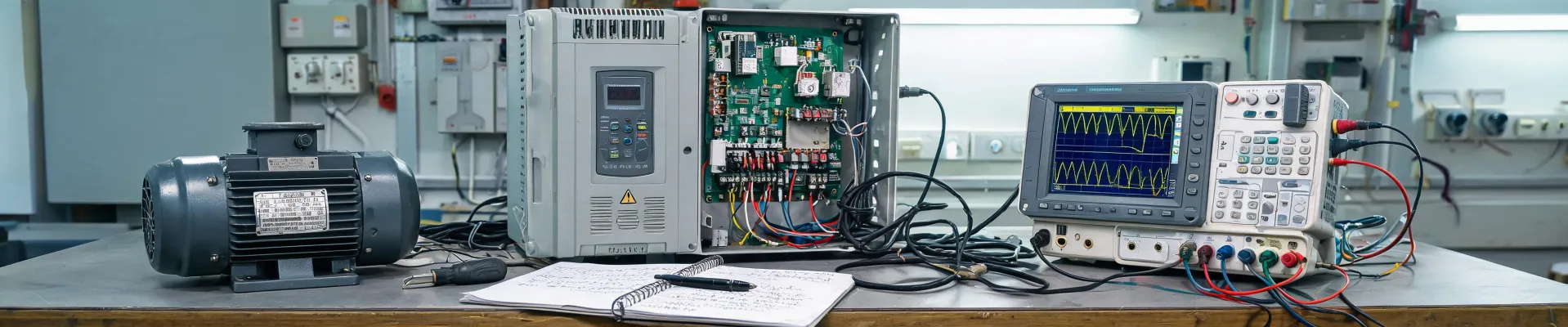
I handle procurement for a small operation—about 45 people, mostly motor-driven equipment on our floor. We buy ABB VFDs, contactors, relays, and a handful of PLC components. Roughly $180K a year across maybe 12 vendors, give or take.
People message me all the time asking "what's the best way to buy ABB VFDs?" I used to give a straight answer. I don't anymore. Because there's no single answer—it depends entirely on which of three scenarios you're in. And I've been in all three.
My experience is based on roughly 150 mid-range purchases. If you're running a plant with 3,000 motors or you're a one-person shop wiring your first panel, your situation is different from mine.
The Three Scenarios (Pick Yours)
Before I get into the details, here's the quick version:
- Scenario A: You need 1–3 drives for a test, a prototype, or an emergency swap. Small order. You're worried vendors won't take you seriously.
- Scenario B: You've got drives installed but nobody on your team really understands programming, fault codes, or parameter setup. You want ABB VFD online training courses and technical backup.
- Scenario C: You're buying enough volume that VFD private label or OEM arrangements start making sense—and you're weighing whether the cost savings are real.
Most generic "drive specification guides" lump these together. They shouldn't.
Scenario A: The Small Trial Order
This is where I started. My first ABB VFD purchase was a single ACS-series drive for a conveyor motor. $340. I called three distributors. Two didn't return my call. One quoted me a 6-week lead time and a $500 minimum.
Here's the thing though—the fourth vendor I found took the $340 order seriously. Asked about the motor nameplate, the duty cycle, whether we needed braking. Walked me through the drive specification checklist like it mattered. Two years later, when I placed a $22,000 order for eight drives plus PLCs and contactors, guess who got it.
Small doesn't mean unimportant. It means potential.
If you're in Scenario A, here's what actually works:
- Lead with the spec, not the price. Tell the vendor: motor HP, voltage, application, environment. Anyone who only responds to price isn't a partner.
- Ask about their minimum. Some distributors will waive it for a first order if the spec is clean.
- Check the PLC catalog too. If the same vendor carries the contactors and PLCs you'll eventually need, you've found one relationship instead of four.
Most buyers focus on which vendor is cheapest and completely miss that the first small order is actually a test—of them, not you. The vendor is deciding whether you're worth investing in. So is the reverse.
Scenario B: You Need Training, Not Just Hardware
This one caught me off-guard. We had drives installed and running, but when a fault code came up on a Friday afternoon, nobody in the building could tell me what it meant. Our electrician could reset it. That was it.
The problem isn't the drive. It's the knowledge gap around the drive.
I assumed "ABB VFD" meant the same thing to every supplier—just the box, the manual, done. Turned out the good distributors offer something else: structured ABB VFD online training tied to the actual models they sell. Not a PDF dump. Actual modules.
If you're in Scenario B, here's what to look for:
- Course content maps to real models. If the training doesn't reference specific parameter groups, fault code families, or the startup wizard on the exact drive series you own, it's not worth the time.
- Access to a technical person, not a chatbot. When I asked about fault F0002 on a Friday, the vendor who called me back within 3 hours is the one I still buy from.
- It should be free or bundled. Legit distributors include it. Anyone charging you $500 for "premium VFD training" is probably upselling.
To be fair, some of this is on us. Nobody reads the manual until something breaks. I've started requiring the electrician to run the drive through its fault-simulation mode on install. Slow at first, saves hours later.
Scenario C: Private Label / OEM Territory
This one's different. Once you're buying 30, 50, 100+ drives a year, the question shifts. Now you're looking at VFD private label arrangements—drives built to your spec, branded under your name, sold by a B2B supply partner.
I dipped a toe into this in 2024. Not because we needed our own brand—we don't—but because I wanted to see whether the cost story held up.
Short version: sometimes yes, often no.
What the brochures leave out:
- Minimum volumes are real. Usually 200–500 units per model before anyone will tool up.
- Firmware and support become your problem. If it's your label, your customer calls you when it fails. Not ABB.
- Certifications transfer, but slowly. CE, UL, cUL—the paperwork can take 6–12 months before the first private-labeled unit ships.
If you're in Scenario C, don't do it because the per-unit price looks nice. Do it because you have a distribution channel that justifies the volume and a support structure to back it. Otherwise, stick with a strong B2B wholesale relationship under the original brand.
How to Figure Out Which Scenario You're Actually In
Three questions. Answer honestly.
- How many drives do you expect to buy in the next 12 months? Under 10 → Scenario A. 10–50 → Scenario B. 50+ with a channel plan → Scenario C.
- Can anyone on your team troubleshoot a fault code without calling the vendor? No → you're really in Scenario B, even if your volume says otherwise.
- Do you have a customer base that would buy your-brand drives? No → don't touch Scenario C yet. The savings won't cover the headaches.
I've watched people jump to private label too early because a vendor pitched it aggressively. I've also watched people stay in Scenario A for years, paying retail on 40-drive annual volumes that should've been negotiated down. Both are expensive in different ways.
My advice—and it's free, so take it for what it's worth—is to start where you actually are. Not where the vendor's commission structure wants you to be.

Rebecca Sloan
Rebecca Sloan is a power distribution and protection analyst specializing in circuit breakers, switchgear, contactors, fuses, surge protective devices, and coordination. She applies IEC 60947-2 breaker requirements, IEC 60269 fuse characteristics, and IEC 61643-11 tests while examining rated voltage, breaking capacity, time-current curves, selectivity, and prospective short-circuit current. She helps engineers and buyers compare protective devices against documented fault levels, installation conditions, maintenance access, and continuity priorities.