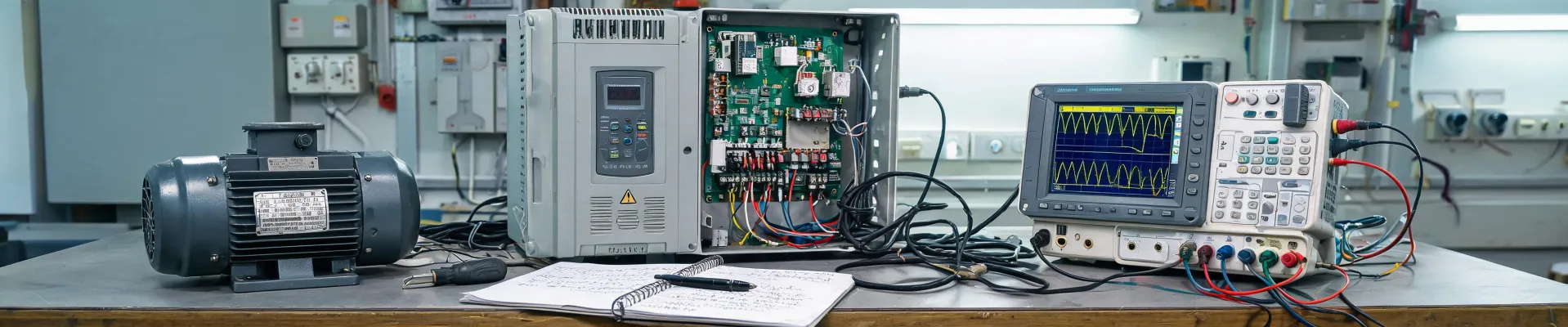
If you're trying to choose between an ABB VFD training course and learning on the job, I'd like to help you avoid the version of that choice that burned me. For the last nine years, I've been the person who orders and checks ABB drives, relays, PLCs, contactors, timers, and the occasional complete control panel. I've personally made eleven significant mistakes that cost my employer roughly $28,000 in rework, delays, and rejected parts. That number is not a boast. It's why I keep a checklist now—and it's why this article is a public version of that checklist.
This isn't a training-is-bad article. It's a comparison between two ways to learn:
- Formal ABB VFD training (manufacturer-led, classroom or online)
- Field experience (the school of the second rejected order)
I'll compare them on four dimensions: system context, controller compliance requirements, cost, and bulk purchasing.
1. Learning the VFD-to-control chain
Formal ABB VFD training gives you something that is hard to get elsewhere: the authorized mental model of a drive. You learn the parameter sequence, the I/O mapping, and the safe torque off wiring. That is valuable. But in my first training class, I remember thinking, we can finally stop guessing why the fault code appears. The next project reminded me that the drive is glued to a controller, a main disconnect, and a bulk contactor order waiting to happen.
Field experience, for me, was where the system picture actually landed. On a 30-pump project in 2021, the ABB VFD was perfectly configured. The controller dry contacts wired into the wrong input group. That was not a training failure. It was a system-thinking failure. Nothing in the course said ignore the controller; but the structure of a course can make the drive feel like the whole story.
Comparison verdict: If you only take the classroom path, you learn the drive. If you only learn in the field, you learn the system, but slowly and painfully. The easy conclusion is do both. The harder one is do them in the right order: formal course first, then supervised field time.
2. Controller compliance requirements: the gap between a certificate and a panel
This is where my training-vs-experience scorecard becomes a bit surprising. Formal ABB VFD training mentions standards like IEC 61800-3 and IEC 61800-5-2, and the general need to apply a drive inside a compliant assembly. It doesn't walk you through a third-party inspection of your panel.
I learned that difference the expensive way. In September 2022, I signed off on a custom control panel where the ABB VFD was correctly grounded and shielded. The bulk contactor ahead of the drive had a coil control strategy that didn't match the controller output card. The panel was stopped at compliance review and sent back. The evidence was right there in the standards, but I had treated the contactor as a commodity instead of a compliance participant.
Everything I'd read said the drive itself meets the safety and EMC requirements. In practice, the drive certificate does not certify the wiring, the controller, or the contactor around it. The subsystem has to meet the same controller compliance requirements as a system.
Comparison verdict: Formal training is more likely to give you the standard names. Field experience is more likely to make those names hurt enough to be remembered.
3. Cost: tuition vs rework
I don't have a perfect ledger for every mistake, because at first I didn't track them. Don't hold me to the exact number, but I'd estimate my first two years of learn-by-doing cost about double what an ABB VFD training course and the travel time would have cost. In 2019, I ordered eighty bulk contactor units based on the main contact rating alone. Every one had an auxiliary contact block mismatch. That error cost $890 in labor to swap them plus a one-week delay—and it wasn't even a large order.
Training has a different cost structure: visible, upfront, and annoying. Field experience hides its cost in rework, rejected panels, and the phrase we'll fix it after the holiday.
Comparison verdict: For the person paying with a corporate card, training feels expensive. For the person paying with schedule credibility, mistakes are worse. I've learned to accept the cash cost of training.
4. What ABB VFD training didn't teach me about bulk purchasing
The biggest blind spot in training is purchasing. A course will show you the optimal drive, the correct controller interface, and the ideal panel layout. It won't tell you how to write a bulk contactor order so the units arrive with the right coil voltage, correct terminal markings, and documentation that matches your controller compliance requirements file.
My first bulk order for an ABB VFD upgrade program was a 120-piece bulk contactor order. I checked the part number, quantity, and price, and ignored the coil data. When the job came back missing the compliance documentation for the coil option, I finally understood why my experienced teammate always ordered through a distributor who could produce the relevant declarations on request.
After the third rejected order in Q1 2024, I wrote a pre-check list. Since then, it has caught 47 potential errors. Most are small. A few would have caused recalls or safety issues.
Comparison verdict: Neither ABB VFD training nor field experience covers procurement details perfectly. Training gives you theory; field experience gives you trauma. You need a checklist.
Which one should you choose?
If you are commissioning a single machine and can take only one path, start with the formal ABB VFD training. It will give you the vocabulary to ask the right questions about the controller and controller compliance requirements.
If you are a procurement or panel-building person, start with your most experienced technician's field stories, then take the formal course. When you already know what can break, the training content has hooks to hang on.
I still have mixed feelings about formal training. Part of me wants to say the field is the only real school. The other part remembers how much faster I understood my second field failure after a class gave me names for what I'd seen on the first. I reconcile by doing both, in that order.
This worked for our 14-person industrial controls shop. If your company has a compliance engineer or a testing lab, use them early; your calculus might be different. And whatever path you choose, put the checklist in place before the order, not after the rejection.

Rebecca Sloan
Rebecca Sloan is a power distribution and protection analyst specializing in circuit breakers, switchgear, contactors, fuses, surge protective devices, and coordination. She applies IEC 60947-2 breaker requirements, IEC 60269 fuse characteristics, and IEC 61643-11 tests while examining rated voltage, breaking capacity, time-current curves, selectivity, and prospective short-circuit current. She helps engineers and buyers compare protective devices against documented fault levels, installation conditions, maintenance access, and continuity priorities.